When Awareness Shrinks and "Depth" Becomes an Illusion
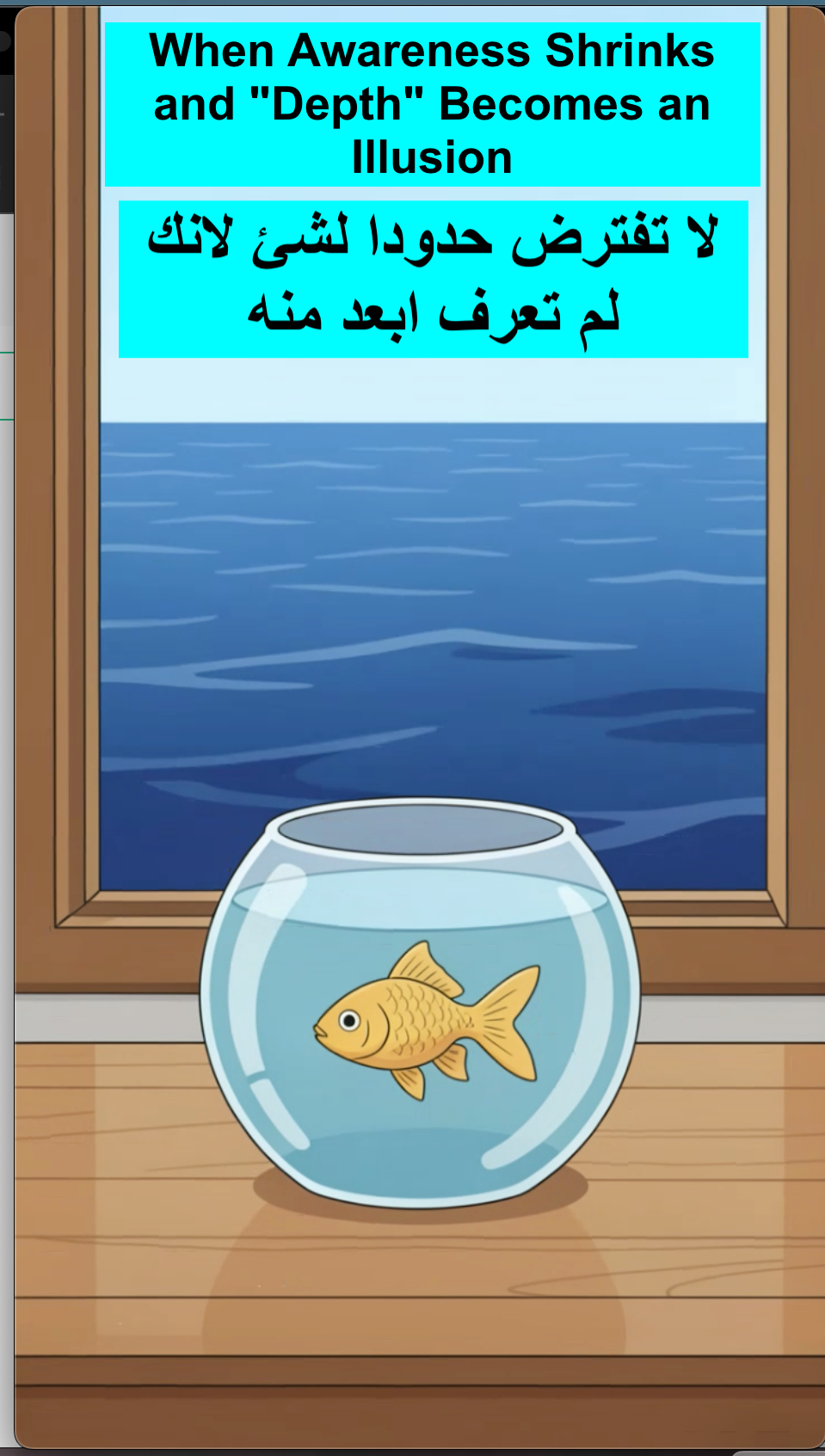
Wisdom tells us not to attempt to explain the depth of the ocean to a fish living inside a small bowl. This proverb perfectly describes the state of mental closure that pervades so many of our daily conversations and debates. The saying opens a window onto a startling truth: our minds, more often than not, are merely reflections of the narrow limits of our own experiences.
What we have not seen with our own eyes becomes difficult to believe. What we have not lived through ourselves appears to us as exaggerated, almost fantastical. The problem here is not a matter of stupidity, as some might hastily assume, but rather a question of the size of the world surrounding the individual. Many people automatically assume that what they know represents the entirety of existence, and that any idea lying beyond that framework is nothing but an illusion.
What is particularly striking about this perspective is its explanation for why some people remain so stubbornly entrenched. They are not arguing to arrive at truth; rather, they are fiercely defending the boundaries of their own limited world. A narrow mind does not simply dislike a new idea; it fears it. This fear is the primary driver of ridicule and mockery. People often laugh at what they do not understand and reject everything that exceeds the ceiling of their limited experiences.
The article offers a golden piece of advice to anyone with a vision or an innovative idea: do not waste your energy trying to convince those who refuse to see. There is an unspoken protocol in the realm of minds, which is that some minds are simply too small to contain an ocean of great ideas.
The conclusion is this: our real battle is not in convincing others; our duty is only to convey the message clearly. We must affirm that the extent of your vision is not the limit of the universe. True awareness is the ability to acknowledge that there is an ocean beyond the boundaries of our sight, even if we have not yet seen it.
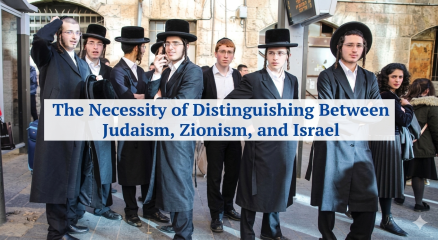
It is deeply concerning to observe the deliberate conflation of the terms "Jews," "Zionists," and "Israel" across Arab and international media. This confusion is far from innocent; it constitutes a dangerous tool that distorts reality and complicates the understanding of the Arab-Israeli conflict. More often than not, this linguistic carelessness serves extremist agendas that seek to infuse a fundamentally political struggle with religious overtones. We must recognize the cunning of politically motivated media machinery. The blurring of lines between Judaism, Zionism, and Israel is not a trivial linguistic error; it is a potent ideological weapon that distorts facts and deepens divisions. Conceptual precision is not an intellectual luxury but a political and moral necessity for understanding the conflict and working toward its resolution. First, we must understand Judaism as a religion and cultural heritage. Judaism is one of the ancient Abrahamic faiths, practiced by millions worldwide as a religious creed and cultural tradition. Jews, as followers of this faith, are not a monolithic block; they encompass a rich diversity of intellectual currents. There are Orthodox Jews who adhere to traditional interpretations, Reform Jews who embrace modernity and adaptation, secular Jews who adopt Jewish identity as a cultural heritage without religious practice, and even Jews who actively oppose Zionism, such as the Neturei Karta community and the Satmar movement. Second, Zionism is a political ideology. It emerged in the late nineteenth century as a nationalist political movement aiming to establish a "national homeland for the Jewish people" in Palestine. Zionism is not synonymous with Judaism; it is a secular ideology at its core, founded by largely non-religious thinkers. It has been and continues to be rejected by numerous Jewish communities around the world, and it primarily serves the interests of the State of Israel, regardless of religious affiliation. Third, Israel is a political state. It is a political entity established on the historical land of Palestine in 1948. Its defining characteristics include its nature as an occupying power over Palestinian territories, its largely secular legal framework with specific religious influences, and its heterogeneous population that includes Muslims, Christians, Druze, and others. Israel is a political reality, not a religious necessity. It is an act of ignorance and extremism to imbue this conflict with religious character for purely political purposes. Transforming a political struggle into a religious one serves Israeli interests by mobilizing unwarranted global religious sympathy, complicating the prospects for political solutions, and ultimately fueling extremist rhetoric on both sides. The conflation of Jews with Israel also provides a convenient cover for anti-Semitism. Legitimate criticism of Israel is exploited as a pretext for racist attacks, political discourse is diverted into ethnic hatred, and harm is inflicted upon non-Zionist Jews who oppose the occupation. When terminology becomes muddled, the Palestinian cause loses its just character as a national liberation struggle and is recast in the global imagination as a religious conflict, thereby mobilizing religious extremists against Palestinians. Equating any criticism of Israel with anti-Semitism, using "Jews" interchangeably with Israeli leadership, portraying Zionism as an inherent part of Judaism, and systematically ignoring the intellectual diversity within Jewish communities, including the deliberate erasure of anti-Zionist Jews, are all harmful practices. We must clearly distinguish between the three terms, highlight the diversity within Jewish society, focus on the political nature of the conflict, and employ precise political language. We should speak of "Israeli occupation," not "Jewish occupation." Jews are our brothers and sisters, and we stand with them as they are an integral part of the fabric of Iraqi society. We cooperate with anti-Zionist Jews who oppose racist Zionism, and we emphasize the importance of separating religion from politics in analyzing this conflict. Prominent examples of anti-Zionist Jewish groups include Neturei Karta, an ultra-Orthodox Jewish group that rejects the State of Israel, believing that a Jewish state can only be established with the coming of the Messiah, and they actively participate in events supporting Palestinians. Early Reform Judaism opposed Zionism, viewing Judaism as a religious identity rather than a political nationality, though their stance shifted after the Holocaust. Today, organizations such as Jews for Peace, movements like IfNotNow, and public figures like Noam Chomsky and Norman Finkelstein continue to oppose the occupation and advocate for justice. Ultimately, justice is the foundation of the universe. Distinguishing between these terms is the first step on the path toward a just and lasting resolution to the most complex and entrenched problem in the Middle East. This distinction preserves the just political character of the conflict, opens the door to broader alliances with moderate Jews who refuse to apply double standards, and isolates the Israeli regime from any religious immunity it might claim. There are honorable Jews who fear God and advocate for truth even against themselves, opposing Zionism and standing for what is right. The first step in confronting this media manipulation and distortion begins with awareness, demanding precision in language, and rejecting simplistic narratives that ultimately serve to perpetuate injustice and occupation. The existence of Israel on Palestinian land is a reality that cannot be denied or ignored. However, denying or ignoring the existence and right of the Palestinian people to a dignified life on their own land is a crime no less severe than the crimes of the apartheid system in South Africa from 1948 to 1994, the Nazi regime in Germany with its Nuremberg Laws of 1935 that explicitly separated Jews from Aryans, stripped Jews of citizenship and basic rights, and paved the way for genocide, or the crimes of America before the civil rights movement, including the Jim Crow laws that legally enforced segregation between whites and Blacks in schools, transportation, and public facilities, while also suppressing voting rights through literacy tests and other political restrictions, a system that persisted from 1877 to 1965.